Welcome to the Library of Questions

Here you will find my articles, images, poetry and excerpts. I talk about art, literature, how not to write book, how to make the camera shake, the art of killing plants, more art and literature, odd films, odd music too, very odd ideas, more art and literature — oh and gardens, lots of gardens. BTW did I mention art and literature? → Go to Library

Please browse, and if you are intrigued, enchanted, angry or engaged, please subscribe to my Substack @SimulistEphimera
It’s fully loaded with interesting stuff (well, I think it’s interesting, so it must be). It’s not intended to provide answers. That’s old style Enlightenment thinking which is great for curing cancer (in other words, really, really great) but tends to the price not the value. This is where, we keep, provisionally, finding value. So it’s a place where we can collaborate on making even better stuff; more questions that lead us to better questions. Go on, sign up, someone has to keep me in check. -> Substack

Illustration of a light-colored snake forming a circular shape in the center of a dark background.

Hamlet said the rest is silence. Thanks for that. Three hours twenty minutes. I need a wee and this is the best you got?

Why we sit, all that time, knees around our ears like an Inca mummy, is that we’ve spent our entire lives trying to work out the same thing as the Scandie Noir Prince (except not dressed just in tights and a doublet): If the rest is silence, what is this bit that isn’t ‘the rest’? For me, at least, this is it.

Simulism posits that it’s the search, not the answers to the search that matter. (The answers are never coming, they are the silence.)

Seeking meaning is the true meaning of our lives.

Simulism - what the rest isn’t

  • Simulism is the aesthetic and ethical philosophy originated by John Rux-Burton.

    It holds that meaning is not discovered but made, forged through the human act of seeking it.

    Against the seesaw of modernist certainty and postmodern irony, Simulism embraces simultaneity: comedy and tragedy, faith and futility, the real and the imagined existing together without resolution.

    The gesture of making — whether through language, image, or landscape — becomes the ethical act itself: an assertion of humanity in an indifferent universe.

    In fiction, Simulism reveals moral truth through satire. In poetry, it finds revelation in the fleeting. In digital imagery, it melts photography into invention. In the garden, it re-enchants matter.

    Simulism is not paradox but coexistence — a celebration of the mind’s need to create coherence, even knowing coherence cannot hold.

  • Imagine you’re sitting in a cave. Imprisoned. In front of you, shadows dance on the wall, cast by a fire behind you. You watch them, laugh at them, feel scared by them, maybe even believe them. This is one of the oldest stories in philosophy, told by Plato over 2,000 years ago. He thought the shadows were fakes, and the “real” truth was somewhere else, outside the cave.

    Simulism says: no — the shadows are our world. They are not lies, but the only reality we have.

    But how did we get here? Western thought has been circling this problem for centuries. Aquinas believed that humanity must have God — and if you believe, that solves everything. But once science made belief in God harder, not because science was wrong but because it left us staring into a void, the question became: if there is no God, what gives us meaning?

    The Renaissance tried to answer with self-fashioning: the idea that a person could shape themselves like art. You know the type — a great man making so much of himself, though in the end it feels hollow. Think of Julius Caesar: it’s Shakespeare’s play we remember more than the historical man himself. Shakespeare saw the problem with this thinking: vanity, or vanitas as it was called then. The glitter of the self began to look empty. It did for Caesar on the steps of the Forum, and it did for that whole school of thought too.

    Cynicism followed. We call this Mannerism. Look at paintings of the time by Vermeer or Velázquez: they sometimes include the painter painting, reminding you it’s all made up. Clever, but hollow. It denies people the meaning they need.


    Mannerism then split. One path was satire, with its austere but baroque contrivances (think of the crude 18th-century cartoons). The other was the Baroque proper, where everything became bigger, louder, richer. You still see that today in salons with their gilded frames and bling. Both paths kept inflating the creations of the human mind — wonderful and terrible alike. By the end of the 18th century this became Romanticism. Think of Mary Shelley’s Frankenstein. That’s what came out of these ideas.

    But Frankenstein isn’t reality. Realism in the 19th century tried to bring us back: “let’s just show the world as it is.” The results were some of the great works of literature: Dickens, George Eliot, Hardy.

    The trouble is, reality is always seen through one person’s eyes. Realism too turned out to be a kind of cheat — one person’s version (and, thanks to power, often a white Englishman’s).

    So the world moved to Modernism, late in the 19th century. Modernism tried another repair by turning inward: one consciousness, one stream of thought, as if the whole of reality could be grasped in a single subjective voice. It produced works like The Great Gatsby. But Gatsby himself, as you’ll know if you’ve read the book or seen the film, collapses under the weight of his own invented self. Fragility — a reworking of vanity — became the emblem of profundity. Once again, the pattern broke down, this time into Postmodernism: a new Mannerism of irony and pastiche.

    Postmodernism left us in a disjointed world: longing formeaning butt finding only irony. Think of Tarantino’s Pulp Fiction. You never find out what’s in the suitcase, and that’s the point — so much fuss about nothing. But “nothing” is a poor lunch for a mind that needs a diet of meaning.


    That leaves us today in a similar fix to when Mannerism ran its course — but with one difference. Now we have scientific advances that earlier thinkers lacked: evolutionary theory, the discovery of DNA, technology. We can say clearly that meaning is not written into the cosmos. And, unlike Aquinas, we no longer need to force God into the story.

    Some modern thinkers have tried to fudge a compromise: sometimes sincerity, sometimes irony. But Simulism does something different. It says: it’s both, always. We don’t need to oscillate between void and fire. Through simulation we hold both truths together at once: the universe has no meaning, and humans cannot live without it.

    That is why it is called Simulism. The word joins simulation (the shadows we invent) with simultaneity (the way we hold the absence of meaning and the need for meaning together as one reality).

    And this isn’t a sad thought. It’s freeing. It means:

    • Art matters — not because it reflects some eternal order, but because it lets us feel, imagine, and share meaning.
    • Ethics matters — not because it’s written in the stars, but because what we do always touches other people’s shadows.
    • Science matters — it shows us how things work, but it doesn’t tell us why they matter. That part is up to us.

    Think of life as a giant group project. Everyone is scribbling, painting, and joking on the same wall of shadows. Some shadows are grand and dazzling, others faint flickers, but they all count. Even the smallest shadow can change the whole picture.

    Simulism is serious, but it also has humour. It says: we know the universe doesn’t hand us meaning — but we’ll make it anyway. We’ll laugh at our shadows, cry over them, decorate them, argue about them. That is what it means to be human: to live in shadows, and to love them. And because meaning is made in how we explain our lives, Simulism carries a moral dimension too: if we are going to use our stories to make meaning, and if those stories join in a dance with the stories of others, then we ought to try to live good lives — lives worth explaining.

    The photographs in the photography section of my website www.johnruxburton.co.uk illustrate the Simulist eye.

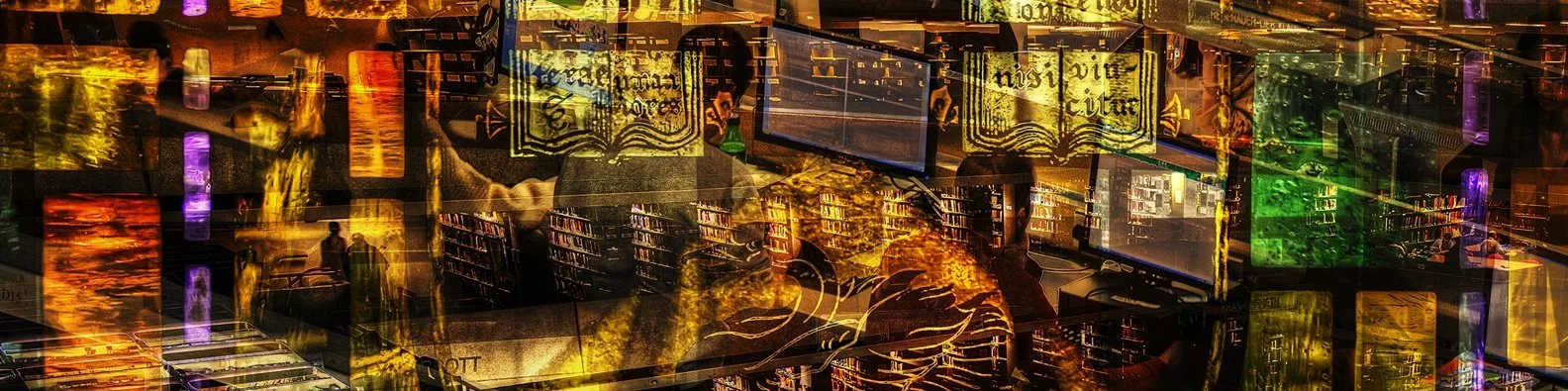
    They begin with literal fragments of reality — reflections, buildings, grids of glass — but I digitally melt them together until they are no longer a simple record of what was there. Instead, the image becomes a field of flickering shadows, inviting the viewer to search for meaning.

    Like the cave in Plato’s story, the photo asks us to sit with the shifting light and make sense of it ourselves.

    It is both fact (it was once glass and steel, water and rock, caught by a camera) and void (it no longer corresponds directly to the world).

    Its truth comes in the meanings we create as we look: each interpretation another shadow in the dance of Simulism.

    Simulism is not simply about visual art. Simulist poetry elevates the trivial and banal and shows how, in the simplest things, we make provisional meaning, finding ways to justify and explain our lives.

    Simulist fiction is patterned by satire and irony as the reader laughs at the void and the folly of the human situation but also wonders at the myths we make about ourselves and our culture. It can be a place of wonder too as it examines how we justify our lives in our faith that life has value despite the inevitability of our demise.

    In gardens, the physicality of the space plays against the symbolic meanings we make about it. Read the garden section on the site to understand this better.

    Simulism holds that for human beings, it is the wonder at trying to find meaning, despite knowing they will fail, that is the true nature of the human experience.

  • Available on request

    → email contact@johnruxburton.co.uk

Podcast

‘A Proposal for Simulism’ audiolised via the experimental process of Notebook LLM

This is an evolving theory. Get in touch, let’s share ideas.

-> Subscribe to @SimulistEphimera on Substack

The Library

John Rux-Burton John Rux-Burton

What is Simulism? New thinking beyond Metamodernism

Simulism argues that meaning is not found in any universal truth or external order, but made in the human act of seeking it. It recognises that our minds are pattern-making engines, compelled to impose coherence upon chaos. This impulse—absurd, beautiful, and often contradictory—is the very substance of meaning itself.

Read More
John Rux-Burton John Rux-Burton

Topogenesthetics - The significance of gardens

Many gardens have deep symbolic meaning. In Japan of course, but across the world.


Topogenesthics is a word I use to describe the study of how spaces are imbued with meaning. Naturally, it has deep relevance in the symbolic gardens of Japan, but it is universal.

Read More
Writing John Rux-Burton Writing John Rux-Burton

The Ghosts Of Swelford Slaughter

Discover an excerpt from The Ghosts of Swelford Slaughter — a darkly comic literary novel set in the Cotswolds, where ghosts, gods, and hedge funds collide. A satire of power, faith, and redemption, complete and seeking representation.

Read More
John Rux-Burton John Rux-Burton

A Simulist Manifesto - Binary to Simultaneity

Extract from “A Simulist Manifesto: Binary to Simultaneity”

John Rux-Burton


My art makes no statement beyond a statement that it is a question — multiple questions.

What is the viewer engaging? Mimesis done awry, or abstraction drawn too well?

Meaning is not discovered but made, each image a dialogue between something and nothing, between the human urge to find order and the void’s indifference.

To see the work is to participate in its making — the moment where perception becomes creation

Read More
Photography, Garden, Poetry, Literature John Rux-Burton Photography, Garden, Poetry, Literature John Rux-Burton

A Dry Stream is full of water, if you look with your heart — Reflections on Karesansui

What does it mean when a garden’s stream runs dry? In Japanese karesansui, absence is full of possibility: gravel becomes river; rocks, mountains; silence, reflection; an entire universe in a handful of dust. Enter a space where meaning is created by the gaze—and discover why, with the right kind of looking, a dry stream can overflow with water and life.

Read More