
Introduction
With the novels now finished, Geoff, the jackdaw, is currently down on his luck. He can’t go back to his old job as a fluffer in peacock porn. The discovery of Viagra did for that. Technology, hey? Writers complain about AI. Don’t they know there are real people out there, with real lives, and real jobs – jobs that matter - suffering too? Inevitably, Geoff’s job at the petting zoo didn’t go well either, so now he’s trying to make it as a voice actor. Apparently roles are limited for birds who can caw in 47 different ways – who’d have guessed? Reluctantly, he’s agreed to give us a recap of the book so far, with all the enthusiasm of a 16-year-old kid, on work experience, on day 2 - but with less competence.
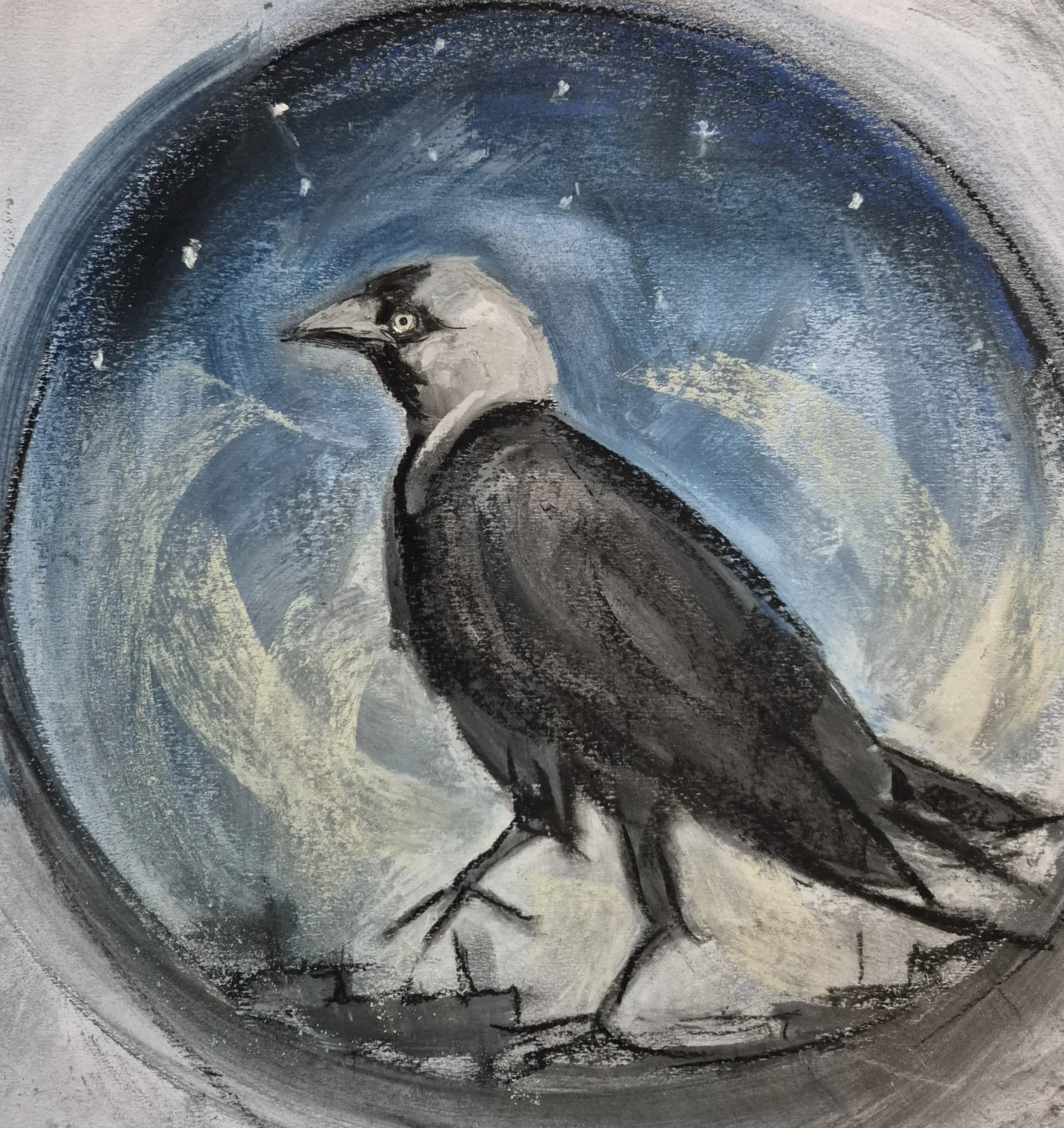
“Hi, I’m Geoff. I’m a bird, a jackdaw. Most people in the Cotswolds have a nickname for me: ‘Sodoff.’ That’s OK. I guess G’s sound a bit like S’s. Given the English can’t pronounce foreign names, what chance have they got with a bird’s?
Let me spin you up to speed, like one of those bicycle things, which of course aren’t really designed for the avian community. Handlebars as a perch? Call that accessibility, performative more like!
First, a trigger warning. The text says:
If you come from a section of society unoffended by these books, please write to me. I will rectify the omission in the next edition.
Guess that’s the author trying to head off complaints. Well, we’ll see how that works out.
Second, it’s got a quote from some Japanese guy who reckons you can see the whole world in a stone. He’s right. You can. In fact it’s a lot more complicated – and simpler - than that. But that sounds a bit like it might suddenly get all metaphysical, or cosmic, or mythic, or stuff. I’ve been told to make sure I don’t give any impression the book has any literary merit whatsoever and absolutely mustn’t use words like ‘moral purpose’. Terrible for sales, apparently. So there you go: I haven’t.
OK, that’s it. Where do I send the invoice?
Oh yes, the book. If I must.
We are in the Cotswolds. The northern bit. The posh bit of the posh bit. Pretty as a chocolate box at Christmas. And with a population as appealing as the same chocolate box on Boxing Day, after grandma has sat on it.
I’ve been hanging around the crumbling ruin of Corbunion Hall with the unspeakable Craddock family: both the dead and those apprenticing for the role.
This morning, I’ve watched the bullying founder of this brood and his verbose, dishonest and perverted antecedents trying to wake up the current head of the family, Nathaniel Craddock. They have failed, like every other day. Why are they trying to wake him up? Because they want him to be miserable: as miserable about being filthy rich and lord of 2,000 acres as they always have been, continue to be and always will be, world without end (which might be sooner than they think). How can I characterise them in a single word? Bastards. Which is ironic, as they’re not. If only they were: it might have injected some genetic improvement.
I have been watching these tossers for 400 years. Why? Well, I don’t know. Or maybe I do. It must be in there somewhere. I mean, three books, 300,000 words. 300,000?? Blimey, that long? There might even be something profound in it. Damn, I wasn’t supposed to mention that. Don’t worry, if there is, it will only be by accident.
Truth is, I do know, but if I told you now, instead of reading to the end of all this nonsense, you’d probably save yourself the bother, use page 37 to wipe your backside and take it back to the library. The book, not page 37 – hopefully! Why do I assume the library? Let’s face it, the State are the only people who will buy this drivel. Anyway, let’s unpack my predicament. If you decide that page 37 is better than Izal medicated (look it up), well, that would be no good, no good at all. No, I need time to plan my escape. I have found, over the millennia, that it’s a good idea to leave the solar system before the reviews come in.
So here we are, this is our titular hero: Albert Wrightson. Or at least he would be, if the books were called The Albert Wrightson Trilogy. But they are not. They are called The Ghosts of Swelford Slaughter. So our titular hero is a ghost, or a Swelford, or a Slaughter. Which isn’t right and sort of is… Two out of three, which, by the standards of the human race and most universities today, is way beyond a First.
So Albert Wrightson, young banker and man-not-about town, is about to be interviewed. The snag: He is smart, educated, and determined. Fortunately, he is also naïve as fuck. Which is great, because the only way he is going to get this job is if he’s too dumb to work out what’s going on. And given the conversations he’s had that day already, he’s going to have to eat the scone of dumbness with double-clot cream, if he isn’t going to spot something’s a-foot, or a-claw (important to be inclusive).
Bye for now. I’ll be back. And not like Arnie, ‘coz I’ll have never been away.”
Geoff
PS I could have been a peacock too, I just never had the beaks.
Extract
From Woodburner of the Vanities - Book I of The Ghosts of Swelford Slaughter
Chapter 2 – A Clattering of Quantum Physics
Albert Wrightson sat outside Caffé Nero, overlooking the Thames, sipping, and reading The Guardian on his phone. Sometime he would pay a voluntary subscription. When he had time to click through. The weather was warm and when it was warm, sometimes, mid-morning, when he had already been at work for three hours, he’d walk down to the river, grab a coffee, and sit for ten or fifteen minutes. So what if the rest of the office thought taking a break was a sign of weakness? He didn’t care. Except he did care, of course. All that ‘banco-wanco’ stuff that his boss Martinez had buttoned him with first thing this morning. Then later, when Albert was popping out, Martinez again, with his usual ability to indicate he was not bilingual but non-lingual, shouting out:
“Oye, mano, enjoy-a your muy bonita Strawberry and White Choco Frappe! Se muy magnifico, se muy macho grande.”
Still, he wanted coffee. And now he was sitting at a bleached picnic table, over the way from the café with a take-out. No, not a frappe! Definitely not. Or one of Martinez’s cortados.
The tables were by a set of steps that went down to a small beach, now submerging under the rising tide. A seagull was perched on the wall between him and the river. It looked like it was watching him. Do seagulls steal Salted Caramel Iced Velvet Americano’s? They might.
A barge, pulling a second barge, was trudging its way upstream. The London Eye in the distance was moving too slowly for the movement to be observed, though moving it definitely was. When he turned his head, sometimes the light would reflect off the tabletop as a small yellow star, too bright to establish details, and then, as he moved his head on, the reflection off his sunglasses would be gone as if it had never existed at all.
From where he was sitting, he could have seen his office, a great bulging, metal and glass totem to architectural inadequacy, rising above the lesser roof tops. But he did not, as his back was turned and he was soaking up the sun, persuading himself he was forgetting he had another ten hours to come that day, forgetting the Central Line tonight, a brief sleep, rinse, repeat.
He smelt of Kouros, which he had been given last Christmas by a girlfriend who happened to coincide with the festivities. The aftershave had lasted longer than the relationship. He was wearing black chinos and a Napapijri fleece because, though it was hot already, it had been cooler when he left home, and when he came out, he had put it back on instinctively because he always felt the cold.
He stopped Ziggy Alberts playing on his iPhone, popped his earbuds back in their case and then neatly into the small side pocket of his rucksack. He went to retrieve his laptop from the main compartment but then remembered that now wasn’t work time and re-did the leather buckle. Across the tables, a couple of girls were drinking frappes and one of them had nudged the other. He ignored them and looked back at the barges, which were now going under the Millennium Bridge. Then he went back to his phone.
He looked at his milk chocolate hands holding the phone - his mum’s description, not his - and realised the sun had tanned them browner still, leaving lighter lines. If his mum saw them – when she saw them – she would probably say that now they were like the chocolate of an anaemic kinder egg, with cracks. Or she would have done. She said less now.
He flicked on from an article about the property trends in rural France and started one on the financial crisis affecting Russel Group universities. He read one and a half paragraphs and flicked on again.
“Okay if I sit here?” A woman’s voice asked.
He glanced up, expecting to see the nudger’s mate, not sure how to say no, but wishing he could. But it wasn’t the girl from the other table, with her matcha thingy and her summer-breeze shirt and her friend egging her on. It was a middle-aged woman, in red dress with pilot pockets and a button-front that stopped short of the knee-length hem, so that it fell slightly open as she moved her freckled leg over the bench of the picnic table. She had her coffee in a keep-cup and her large sunglasses on her brushed up ash-brown-sleek-bobbed hair. It seemed to be held up by a lot of product.
He expected her to speak to him. She looked as if she would. But she did not and she picked her phone out of her bag and started scrolling, as if perhaps checking emails, her hazel-coloured eyes scanning the screen quickly, fingers moving quicker.
He went back to The Guardian and his iced coffee. He tried to look as if he, too, was reading an article, but the woman was distracting. Why had she sat opposite him? There were at least three other free tables?
He took a sip and dabbed his mouth with the small paper towel that had accompanied his drink. The wet ring on the towel, from where the glass cup had sat, wetted his lips. It was a little slimy. He found a dry bit and dabbed again.
“Well, that’s that job done,” said the woman. “I’m Penny, by the way.”
“Oh,” replied Albert.
“Well, there you are.” She shrugged slightly. “I do hate checking my emails all the time. It’s a rule I have, emails first thing, then no more until I have my mid-morning coffee. Then I sit down, quick urgent stuff done, head clear. Me time. Think time. Then I can be strategic. It’s important, don’t you think? Everything in its place. You know, work-life balance.”
“I suppose so,” said Albert.
“Yes, I suppose you do. But you know that, don’t you? I mean, I can see it. You’re here, it’s 10.37 and you’re not rushing somewhere. You can see it’s a beautiful, beautiful day and - you’re taking your time. That’s it, isn’t it?”
“I’m not really taking my time. I work down the road. I’ll go in a minute. I only take 15 minutes.”
“Oh, so time matters then?”
Albert wasn’t sure what to say. He gave a shrug that could have been interpreted as ‘yes’ or ‘no’, or more accurately ‘please go away’.
“What’s your name?”
“Albert,” he replied, before wondering why he had told her.
“Well, Albert, here’s the thing: I do care about time. And I have a meeting at half past eleven and I don’t want to be late, so I came from my office early, and I’m having a drink, and relaxing, and that way I will be prepared and ready, and on time, and be my very best. And then I saw you and I thought, that would be a nice person, maybe, to speak to, for a little. You see, I don’t hold with all that stiff British don’t speak to strangers. What do you learn if you don’t speak to strangers? I mean, if you speak just to people like you, well, all you’ll know is what you know, which isn’t very much, now is it? So, I thought, I’ll speak to him and then off to my meeting and on with my day.” She paused, as if done, then added “So where do you work?”
“In a bank, down the road.”
“Of course. This is the City, everyone works in a bank. What do you do, in your bank, down the road?”
“It’s not my bank.”
“No,” said Penny earnestly “But I bet you would like it to be, wouldn’t you?”
“I don’t know. I haven’t really thought about that.”
“Oh, come on, everyone thinks about things like that. I bet you’ve thought about it; if not that, then when your bonus will top a million pounds. I bet you have.” She paused. “Oh, I’m sorry. Maybe it already does. I just assumed. I mean you look quite young.”
Albert shook his head. “It’s not a million pounds.”
“No, but you’d like it if it was.”
“I suppose so.”
“A million, and a nice flat somewhere and some girl, or boy, waiting on your Heal’s sofa, with Celeste on Spotify and a G&T already poured.”
“I’d probably prefer a beer.”
“Yes, but you’d have a G&T, now wouldn’t you, if it was offered? Anyway, about that million pounds. Let’s imagine, just for a moment, I’m not here waiting for a meeting. Imagine I was a head-hunter, and I was working for a client, who wanted to pay a bright young man a million pounds to come and work at their bank. What would you be saying to me then, heh?”
“I’d say, but you’re not a head-hunter, you’re waiting for a meeting, and I really need to go now, or I’ll be late.”
“Yes, but imagine. Or imagine I’m not. Imagine I am a spy. Imagine I have started talking to you because I want to recruit you for an organisation a bit like MI5 but much more secret. What would you say then?”
Albert was sure he needed to get rid of this weird woman as soon as possible. “Would it be dangerous?”
“Oh yes, very dangerous indeed. And compromising.” At this point, she leant forward slightly, and her eyes flashed.
“I’m not sure that’s really me. I might rather go for the million quid.”
“But the role with the, eh, agency, would be frightfully, well, I mean covert, total deniability.”
“I think I’d rather work at the bank. I mean, it’s all above board. They are very respectable, there’s a good career progression, and it’s relatively secure. I’m not sure I would be cut out for being a, well, for intel… or security or whatever it is you’re offering me.”
“Goodness, I’m not offering you anything. I was just having a bit of fun. Well, mostly. I mean I am helping someone look for a young man, with a bright future, worth a million pounds and eager to get on.” She paused. The gold letters on the side of her sunglasses glinted in the sunlight as she turned her head and looked up the river towards the City and the Shard. The light was shining off those buildings too. She turned back and looked straight at him: “Is that you, Albert?”
“Well, yes, I suppose it is. Except, I have a job. And I wouldn’t simply run off to somewhere else over coffee. That wouldn’t be, well, …”
“Sensible?”
“No, right. And anyway, my boss kind of told me this morning that he was putting me forward for a special job, for the, well, something important. If he’s done that, well, I need to do that first, don’t I? I mean, before I think about doing things for someone else.”
Her eyes flashed, just for an instant, and then the look was gone. “Fair enough.” She paused. “So, you didn’t tell me what you do at this bank.”
“No. No, I didn’t,” said Albert, rather pleased with his reply, rather feeling it was what a spy might say. And with that he got up, nodded to her, turned, and walked off towards his office. Martinez had no idea. He chewed the words ‘banco-wanco’ over in his mouth. Then he spat them out and hurried on.
When he was out of sight, Penny dialled a number from her favourites. “Sir Stanley, yes, I think you’re right. He is perfect for what you have in mind.”