
Writing
I write fiction, poetry, and essays that chase meaning through absurdity and beauty — and sometimes catch it by the tail — not a tiger, a chimera.
And, given chimeras aren’t endangered, I intend to keep hunting them — though they have a nasty nip, or satisfying purr, often both.

Fiction
In fiction, I explore how myth and satire reveal the cracks in what we think of as truth — and how imagination can fill them with something more human. It’s probably worth saying how I write fiction (poetry is a bit different and that you will find further down this page). Method, in both forms, is central to my Simulist bent.
If you enjoyed a misspent youth in the post-modern pool-halls of creative writing schools, you’ll have learnt a lot about mannered writing. Not surprising: post-modernism was mannerist fan fiction; just as every book is a fan fiction since the Iliad.
My fiction isn’t mannered, not at birth. I potty-train it afterwards.
I just write, whatever comes. It’s odd, always being the first person to read my work. Often I do a McCartney: not rewrite Yesterday, but wake up with the next idea more or less complete. When I started my trilogy, The Ghosts of Swelford Slaughter, I threw in a scene with a cosmic jackdaw sitting on the Silus Oak. No idea where the name came from. Two years and 300,000 words later, I (the reader inside) went, “Ah, so that’s why that author bloke put that in!”
Method: Something saved to the cloud, whatever comes out. Go with the flow. Then comes the edit. Hercules, the Augean stables? You never had it so good!
Simulists value the act that makes meaning: the ornamentation, the fleuronation, the rococo tendrils thought stretching outward. But someone needs to come running with a niwake ladder and some shears.
That’s why, for several years, I have had clippers, comb, and pomander in one hand, and a tail in the other; not of a chimera; rather the tale of The Ghosts of Swelford Slaughter.
-> For poems, short stories and project updates
follow @SimulistEphimera

The Ghosts of Swelford Slaughter Trilogy
by John Rux-BurtonA reluctant hero.
A broken heir.
A village that refuses to stay dead.
In Book I of the trilogy, Woodburner of the Vanities, England’s past and present meet in the state of metaphysical disrepair that is the Cotswolds today. Between hedge funds and hedge magic, the living and the dead, the powerful and the powerless, everyone is searching for redemption — though few recognise it when they find it.
Albert Wrightson, an outsider yearning to belong, a young man heading for the path more travelled, and Nathaniel Craddock, the damaged scion of privilege, circle each other through ambition, inheritance, and guilt.
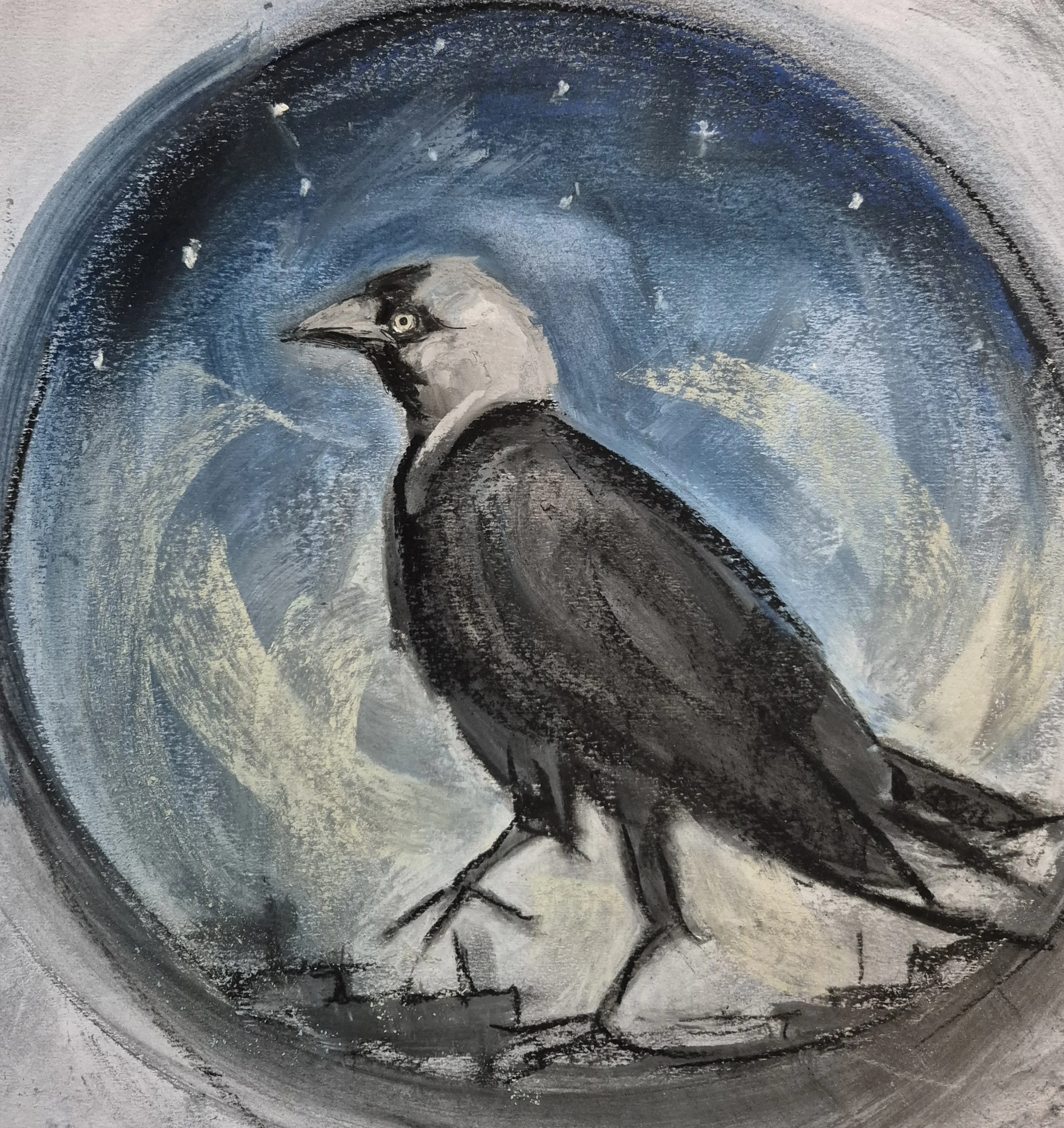
Between them lies Miriam, whose death doesn’t end her influence, and Geoff — a sardonic jackdaw with the cosmic perspective of a god and the patience of an irascible, meddling, all-seeing, all-know-it-all saint… without the saint bit.
“Sooner or later I’m going to have to save the universe. I don’t know if I can be bothered this time.”
Raucously funny, elegiac, and occasionally apocalyptic, the trilogy is a story of ghosts, gods, and human folly — a satire that believes in grace, a comedy that dares to take redemption seriously.
A novel stupid enough to think the English Pastoral hasn’t had its life-support switched off.
Geoff, of course, would tell you that meaning is overrated. (But then he would say that, wouldn’t he?) And that it’s all made up.
Geoff, you just erased yourself from existence. Oh, you knew that? Well great! Thanks! Bang goes that then.
The Ghosts of Swelford Slaughter Trilogy
Complete and seeking representation
“Like A Modest Proposal, ghost-written by Hardy, with gags by Vonnegut and the Carry On team, and zero brokering of Shakespeare’s wit.”
Book I — Woodburner of the Vanities (print-ready)
Book II — Of Ghosts and Grockles (advanced edit)
Book III — The Sheelanagig (advanced edit)
La commedia è (almost) finita.
Read an extract from the first book of the trilogy
Woodburner of the Vanities
with intro by special guest “Geoff the Jackdaw”

Poetry
Writing poetry isn’t like fiction;
it can’t be poured out and then sorted out.
It’s easy to just speak without direction and see what happens .
Most of us do that all the time.
I certainly do.
But one cannot sing like that.
My poetic process is ear first.
Beat second.
Then the jumble.
Then the jumble sale.
And finally, tidying the wardrobe.
I write poems anchored in Simulism,
and weighted-up by the Western Canon…
and I write haiku weightless as a whisper
on a mountain-forest breeze,
when there’s nobody there
and none will come.
-> For poems, short stories and project updates follow @SimulistEphimera

A Haiku of Solar Terms (2020-2026)
by John Rux-BurtonThis project began on 4 February 2020, on the eve of a world turned inside out.
I decided I would write one haiku each day, charting the turn of the season through the optic of the Sino-Asian solar terms. These divide the year into 24, rather than 12 parts. Each is divided into three. The Terms and the sub-divisions all have evocative names: Corn in Ear, Deer Shed Antlers, White Dew. Charting the movements of nature against such a clock demanded I look deeply - as haiku ever does.
Six years on, I am returning to this project, the world changed by those events forever. I will publish one haiku each day of the solar calendar 2026, paired with an image taken in my garden Where the Whale Talks to the Stars.
Each poem will exist in tension with its image. It will be arranged so you may see the words, or the picture — but not both at once.
To read, you must close the image.
To see, you must let the words disappear.
Meaning is not in the text or the picture but in the reader’s gesture: the choice to open, close, return; once, not at all, or many times. In between will be found what the Japanese call ma — the living pause where interpretation begins. In the Simulist sense, it will elaborate that meaning is not given. It is made.
What follows is five of the poems from this series (images will follow, of course, as they emerge during the publication process).
夏至 Geshi
“Summer Reaches Its Height” or “Summer Solstice”
(2020): June 21 – July 6
Day 1Summer Breeze Haiku
sun blossoms shimmered
on cushions by the window
outside blossoms fell
Day 2Ma Haiku
dinner was at dusk
moons craned over fading fields
words craned past silence
Day 3Hot Night Haiku
sleeping in the heat
dreams came with pollen tingles
wrestling restfulness
Day 4Entanglement Haiku
she’s in the garden
sharing the song-birds I hear
through the closed windows
Day 5Passing Seasons Haiku
as I grow slow old
the brevity of summer
is precious cruel
蟬始鳴 Semi hajimete naku
“Cicadas begin to sing”
kō 30
Poems
Sometimes the smallest things — a candle, a poster, the cheap ceramic fish swimming round a clock — are the whole biography of love.
We make shadows on the wall of the cave with our fire, but these flicker out. But, like the relics of a saint, the littlest things can recall memories in others that, from their fire, cast again shadows on the wall of humankind.
Thanks John Donne and Chris Martin… you felt that too.
(The following is from a forthcoming collection.)
The White Board Wall
by John Rux-Burton“The wall looked like a white-board,
now it does not,” you said and went out.
Me on the sofa
with a tea
and you… out.
Clocks tick –
The jokes you made whilst still at school;
and round the face swim fish of China,
China made,
and gaudy too:
Blue-yellow, yellow-blue,
lip-red pinks
and orange festive hues.
Two rackets hung aside from hooks
making a sporty claim
to those who came
to proto dinner parties
as you played the game
of adulthood.
Below the dial
The Ministry of Silly Walks
and a poster not of Cleese
but beer and cheese;
the festival of it,
that your step-dad made
again this year as he has ever made,
year on year,
since you moved away…
away “from here to there”
… to him.
But did not — that simply isn’t true.
That’s only me assuaging guilt,
my head buried deep below a quilt
of shame.
Last there is an egg;
fried and stuck like a flying saucer,
circus-flattened-pancake fuck
of wax and wick waiting to be lit.
Who sticks a candle on a wall?
You…
of course!
Like all the things you do.
Made special by the hugs
at airports, trains and car door frames,
like pictures stolen upon phones,
love for half an hour or two on loan,
then gone again…
you
gone
again.
I laughed at all those jokes
when you were small,
and now you’re tall,
with boyfriend, flat and all,
I laugh again:
as though, as though
you never really once were here,
never once were gone,
but as the flicked-through pages of a novel,
smiling, nodding often,
but put down,
returned onto the shelf,
slipped from the shop,
buy latte,
make a call,
walk again around the shopping mall,
look in,
see book in window,
you reflected in the glass
and fail to go in.
Get on with life,
the book not fully read,
neither prose nor dreams.
Now
it is the laughter from those skimmed-through pages
that remains.
And if you find that far too Larkinesque,
remember, it was he, not I,
who plagiarised our lives
of wistful sadness,
wistful happiness.
->Read After Midnight by John Rux-Burton
A poem written on lighting the first fire of winter
For more of my poetry and other work follow @SimulistEphimera

Non-Fiction
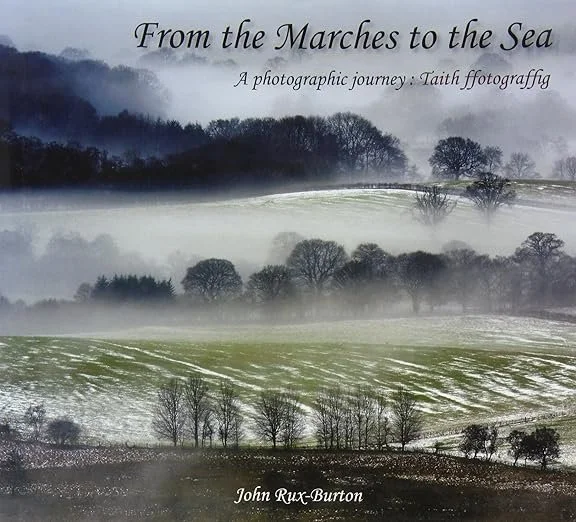
From the Marches to the Sea (2012)
by John Rux-BurtonA journey through the “National Park that never was” — the shifting landscapes of Mid-Wales, from border to coast.
At once travelogue and meditation, the book pairs photographs and text in dialogue: the image grounded in the real, the prose pushing toward meaning.
It’s where my earlier photographic work and my later Simulist thinking meet — the moment I began to look at the world not just as something to be recorded, but as something that makes and remakes meaning.
Still in print, From the Marches to the Sea has quietly reached more than 2,500 copies sold, and judging by its near-constant circulation in Mid-Wales libraries, many more readers. A modest success that has proved there’s an audience for work that sits between art and landscape, photography and philosophy.
Across fiction, poetry, and image, the work begins in the same place: with the act of looking, and the human need to make meaning.
A Sense of Place
(my next non-fiction work)
From the Marches to the Sea explored one landscape. A Sense of Place crosses continents — tracing where great poems were written, and how landscape becomes language.
From Wordsworth’s Lines Written a Few Miles above Tintern Abbey and Lord Byron’s Lachin y Gair, to Kendall’s A Midsummer Noon in the Australian Forest and Frost’s Storm Fear, the book follows the terrain of the imagination: how geography, weather, and solitude shape the rhythm of verse and the weight of meaning.
It is part travel writing, part literary archaeology, part art criticism (both through text and the images I am making of places). Many locations are known by millions from the text but far fewer have stood at the spot. It asks how a place influences the senses, and how the mind — through art — remakes it.
It continues my exploration of topogenesthetics — the study of how spaces become charged with human significance. More importantly it attempts to bring a new focus of enquiry to bear on some of the greatest works of literature in our language.
Sections in progress from A Sense of Place follow below.
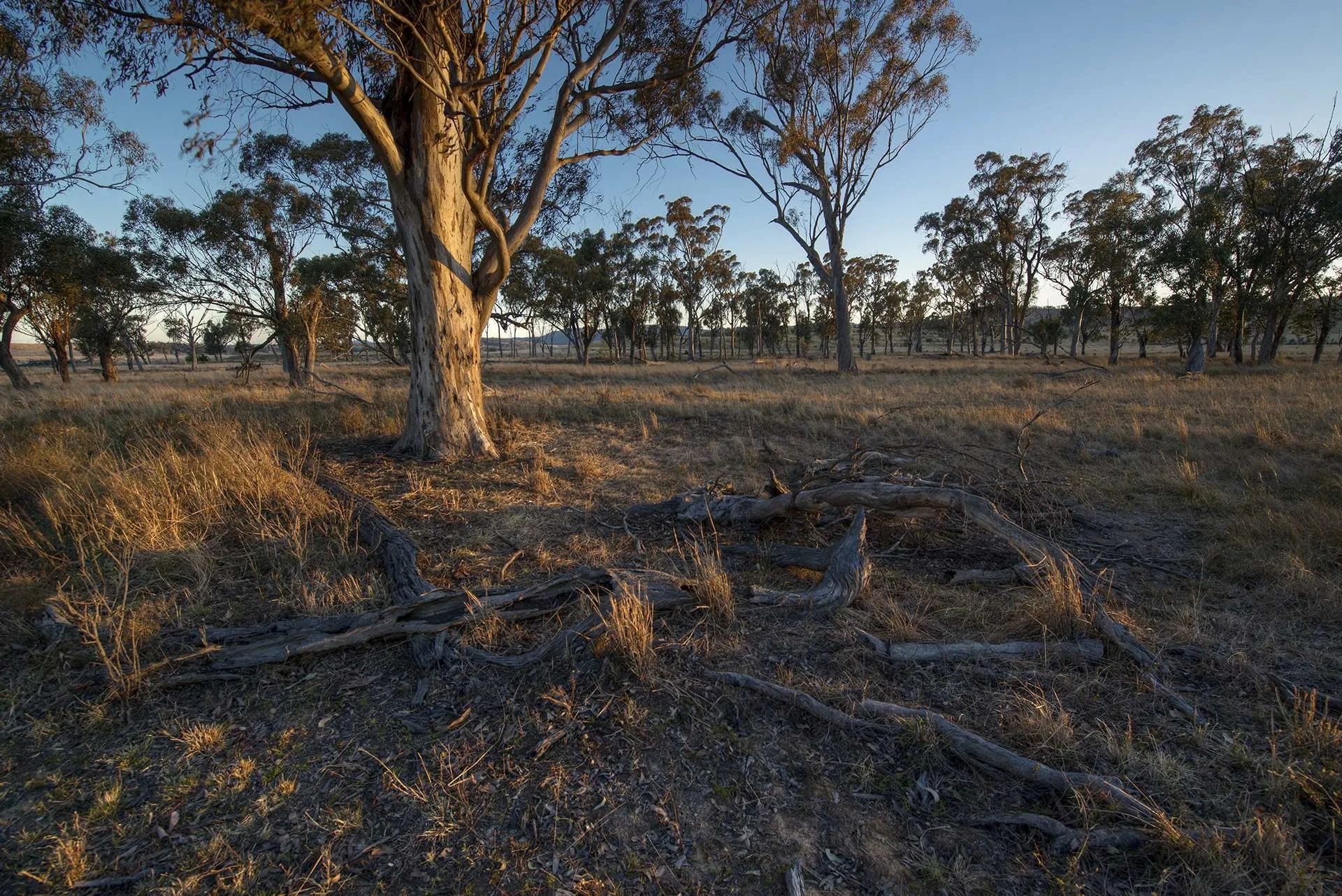
A Midsummer Noon in the Australian Forest - Henry Kendall
by John Rux-BurtonIn 1851, Henry Kendall was working at Great Lodge, an enthusiastically named log-cabin ranch in the Hunter Valley.
It was here he wrote the iconic Australian landscape poem A Midsummer Noon in the Australian Forest. Reaching it then meant a riverboat and eighty-five miles on foot.
The poem describes a land poised on the edge of wilderness. The stasis of summer mid-day heat metaphors a desire in the poet to escape in peace from the heated, noisy clamour of the world; that he can take shelter like the flora and fauna until it goes away.
O 'tis easeful here to lie
Hidden from Noon's scorching eye,
In this grassy cool recess
Musing thus of quietness
Within five years the railway reached the nearest town, and Sydney was then only four hours away. The frontier was gone — for better or worse.
Today, it is worse.
Soon this land will fall to open-cast mining; it was only a few hundred metres away when I made this photograph.
It may already be gone.
Lachin Y Gair - Lord Byron
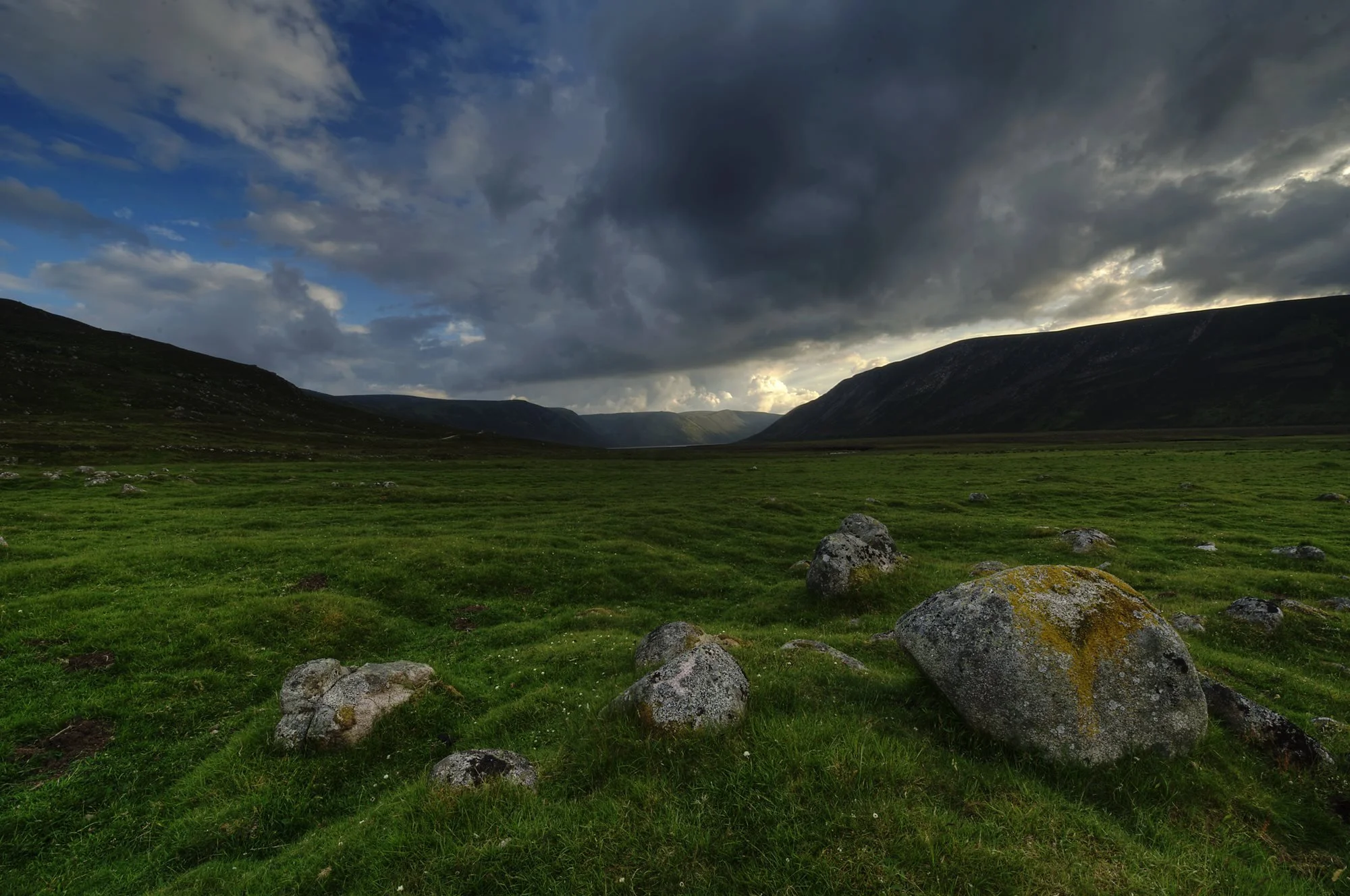
Lochnagar is where Byron spent formative years. They left a gothic impression:
“Shades of the Dead… on the night rolling breath of the gale”
yet still he pined
“Oh for the crags” [of] “dark Loch na Gair.’”
Such obsessions, terror and desire, tells us much of how place influenced a man famously ‘dangerous to know.’

Western Australia
John Boyle O’Reilly: Fenian, transported convict/political prisoner, editor Boston Pilot, poet, novelist; admired by Whitman, Emerson, Wilde and Yeats -
and now a wine bottle label…
A Sense of Place will tell of one of the most incredible escapes ever: how he lay in the sand-dunes of the Leschenault Estuary for three nights, how he made it to America, via Liverpool… and it will tell of the indelible impact of landscape displayed in his collection Poems from the Southern Ocean most especially his work Western Australia.
(coming soon to my Substack)
-> read the complete section